← Blog
awningspermitsmelbourneretractable awningsheritage overlaybuilding regulationsvictoria

Do You Need a Permit for an Awning in Melbourne?

Most retractable awnings on a Melbourne home don't need a building permit — but heritage overlays, encroachment over public land, commercial properties, and apartment buildings all change that. Here's how to check.

By ASG Shading·

TL;DR: For most Melbourne homeowners installing a retractable awning on a private home, no building permit is required — wall-mounted retractable awnings are treated as building appendages, not new structures. But heritage overlays, commercial properties, awnings overhanging public footpaths, large fixed awnings, and strata/apartment buildings all change that. Here's how to know which side of the line your project falls on.

The Short Answer

A standard retractable awning bolted to the wall of a single-storey or double-storey Melbourne home generally does not need a building permit. The reason: under Victoria's Building Regulations 2018, a wall-mounted retractable awning is treated as a building appendage — an accessory fixed to an existing wall — rather than a new structure on the title.

That covers the vast majority of residential awning installs we do at ASG: a cassette or open-arm awning bolted to the brick or rendered wall of a private home, retracting fully into its housing when not in use.

But the picture changes the moment one of these conditions enters the chat:

  • The property is in a heritage overlay
  • The awning will overhang a public footpath, laneway, or property boundary
  • It's a commercial property or shopfront
  • The building is an apartment, townhouse or unit under an Owners Corporation
  • The awning is very large (over 25 m² of coverage) or fixed-roof rather than retractable

We'll walk through each one below.

When You DON'T Need a Permit

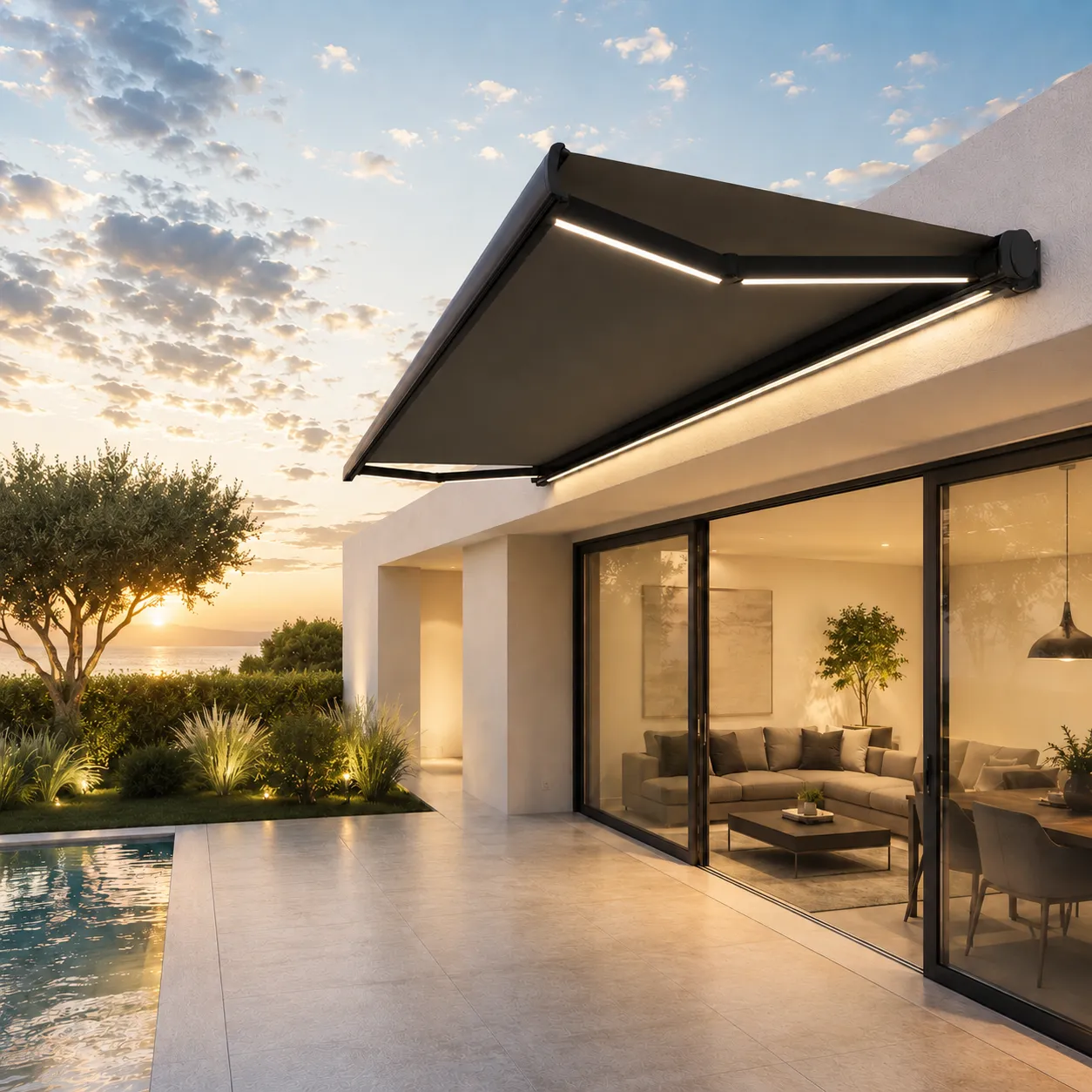
Wall-mounted retractable awning extended over a private patio at a suburban Melbourne home
A typical permit-exempt install: wall-mounted retractable awning on a private suburban home, projecting over the homeowner's own patio.

You can almost always skip the permit process if all of these are true:

  • It's a private, freestanding residential property (not strata, not commercial)
  • The awning is retractable — i.e. the canopy stows away into a cassette or hood when not in use
  • It's wall-mounted to your own home, not freestanding in the yard
  • It doesn't overhang a public footpath, road, laneway or your neighbour's property
  • The property is not in a heritage overlay (we'll cover how to check)
  • The maximum projection is under 3 metres from the wall in most cases
  • It doesn't affect stormwater drainage for you or your neighbour

This describes the typical install for ranges like our AW01 Full Box Awning, the B06 Premium Open-Arm Awning, and the B05 Traditional Scalloped Awning on suburban Melbourne homes. The awning fixes to the existing brick or render, projects over your patio or windows, and retracts neatly when you don't want shade. No structural change to the dwelling, no encroachment, no permit.

Quick sanity check: if your home isn't heritage-listed and the awning won't project beyond your own land, you're almost certainly clear. Drop us your address and a couple of photos and we'll confirm before you order.

When You DO Need a Permit (or Council Approval)

Even if your awning sounds simple, any of the following triggers a permit, planning approval, or written consent. Skipping it can mean fines, forced removal, or trouble at sale time.

1. Heritage Overlays

This is the single biggest reason a Melbourne homeowner needs council approval for an awning. If your property is in a Heritage Overlay (HO), any change to the visible facade — including a wall-mounted awning — generally requires a planning permit from your local council.

Heritage overlays are common in:

  • Inner-north suburbs like Fitzroy, Carlton, Brunswick, Northcote and Clifton Hill
  • Inner-east suburbs like Hawthorn, Kew, Camberwell and Malvern
  • Inner-west suburbs like Williamstown, Yarraville, and parts of Footscray
  • Bayside areas like Brighton, Elwood, St Kilda and South Melbourne
  • Older outer suburbs with Federation or Victorian-era homes

The easiest way to check is to look up your address on the VicPlan tool from the Victorian Government, or call your local council's planning department. If the property sits inside an HO, plan on a planning-permit application before you order an awning.

2. Encroachment Over a Public Footpath or Boundary

If your awning will project over a public footpath, road reserve, laneway, or your neighbour's land, you need explicit council approval — even if the property itself isn't heritage-listed.

This catches a lot of commercial shopfronts and terrace houses where the front facade sits directly on the footpath line. In those cases the council issues a separate building over a footpath / encroachment consent, which sets minimum clearance heights (usually 2.4–3.0 m above the footpath) and requires public-liability insurance for the structure.

3. Commercial Properties

Retractable cassette awning over the footpath of a Melbourne café shopfront
Commercial shopfronts overhanging a footpath need a building permit plus encroachment consent — almost without exception.

Commercial premises — cafés, restaurants, shops, offices — almost always need a building permit and council planning approval for any new awning, regardless of size. Awnings on commercial buildings are governed by BCA Volume One for non-residential construction, which has stricter wind-load, fire-rating, and signage rules.

If you're a business owner planning an awning for a Melbourne shopfront, expect to engage a building surveyor, get a planning permit if the building is in a heritage or commercial overlay, and submit engineering certified to AS/NZS 1170 (Wind Actions).

4. Apartments, Townhouses & Strata Buildings

If your home is under an Owners Corporation (OC) — most apartments, units and townhouses — you'll need written OC consent before fixing anything to a common-property wall, even if no council permit is required. The OC may also require the awning to match a specific colour, fabric or model to maintain visual consistency across the building.

Get it in writing before you order. A verbal "yeah no worries" from the OC manager isn't worth much when the body corporate complaints start arriving. Get explicit written consent that names the model, fabric and mounting position.

5. Large Fixed Awnings or Verandah-Style Structures

A wall-mounted retractable awning is an appendage. A fixed, solid-roof awning over a deck or patio — sometimes called a verandah in building law — is a different beast and almost always needs a building permit, just like a roofed pergola.

The trigger is roughly: floor area over 20 m², roof height over 3.6 m, or any waterproof fixed roof. If you want a fixed all-weather cover over a sizeable outdoor area, that's a verandah, and your installer will need to arrange a building permit, structural engineering, and a building surveyor.

Our A09 Long-Projection Awning sits in an interesting middle ground — it's still retractable and wall-mounted, but with projections up to 4 m and reinforced arms. For projections at the top of its range, double-check with your council whether the size triggers a building permit requirement in your municipality.

Heritage Overlays — A Closer Look

Period-appropriate scalloped retractable awning over the front window of a restored Victorian-era terrace in inner Melbourne
A period-appropriate scalloped awning over a restored Victorian terrace. Heritage overlays will approve awnings — they just care about fabric colour, hardware visibility and reversibility.

Because heritage overlays catch more Melbourne homeowners off guard than anything else on this list, it's worth a closer look.

Even within an HO, awnings are often approved — councils generally accept that they're reversible additions (they unbolt without damaging the heritage fabric of the building) and that they help homeowners use their property year-round. What the council will care about is:

  • Fabric colour — neutrals, period-appropriate stripes (think the awnings on a Victorian-era shopfront), or muted modern tones tend to be approved more readily than bright modern prints
  • Mounting location — over windows or doors is more sympathetic than across the full facade
  • Hardware visibility — full-cassette models like the AW01 hide the mechanism when retracted, which heritage officers usually prefer over open-arm designs that leave the rolled fabric exposed
  • Reversibility — the awning must be removable without damaging original brickwork, stonework or render
6–10 Weeks heritage permit
1–3 Weeks standard install
37 Sauleda fabric colours
5 yr Fabric warranty

Expect the planning permit process to take 6–10 weeks from application to decision, depending on the council. We don't manage council applications ourselves, but we'll happily provide every spec, drawing and structural data sheet your application needs (see below).

Planning Permit vs Building Permit — What's the Difference?

This trips up a lot of people. They're not the same thing, and you may need one, both, or neither.

Permit typeWho issues itWhat it covers
Planning permitYour local councilWhether the project is allowed on this land — heritage rules, zoning, overlays, neighbour amenity, streetscape impact.
Building permitA registered building surveyor (private or municipal)Whether the structure is safe and compliant — wind loads, fixings, engineering, materials, footings.

For a typical residential retractable awning outside a heritage overlay, you need neither. For an awning in an HO, you usually need a planning permit but not a building permit. For a large fixed awning or verandah-style cover, you usually need a building permit, plus a planning permit if you're in an overlay zone or near a boundary.

What Documentation We Provide

ASG installer inspecting a finished awning for quality and structural compliance before dispatch
Every kit is bench-tested at our Hoppers Crossing warehouse and shipped with the engineering data your council or surveyor will ask for.

ASG is a supply-and-install specialist, not a permit consultant. We don't lodge applications on your behalf, but we provide every document a council, building surveyor or Owners Corporation will reasonably ask for:

  • Product specification sheet with all dimensions, weights, projections and clearances
  • Fabric data sheet from Sauleda — UV rating, fire classification, fade warranty, fabric weight
  • Structural engineering data certified to AS/NZS 1170 (Wind Actions) and AS/NZS 1664 (Aluminium Structures)
  • Fixing detail drawings showing how the cassette attaches to brick, render, or timber framing
  • Motor & control specifications for the Dooya drive — the most-installed tubular motor worldwide
  • Photos of similar installs at neighbouring properties when heritage officers ask for streetscape precedent

Hit "Get Price" on any product page or send us your address and we'll include the relevant documentation pack with your written quote.

The Practical Roadmap

If you're a Melbourne homeowner thinking about an awning, here's the order to work through it:

  1. Check VicPlan for your address — does it sit in a heritage overlay, flood overlay, or bushfire zone?
  2. If yes — phone your council's planning department before ordering. Ask whether a planning permit is required for an external awning at your address.
  3. If you're in a unit, townhouse or apartment — read your OC by-laws and email the OC manager for written consent.
  4. Pick a model and fabric — talk to us, send a few photos of the wall, and we'll confirm sizes that will work. We'll send you the spec pack you need for any application.
Sauleda awning fabric swatches in five neutral colourways
Pick a fabric early. Heritage councils tend to approve neutrals and period-appropriate stripes faster than bright modern prints, and it's often the longest lead-time item.
  1. Lodge the application if one is required — your council planning team can walk you through their specific forms and fees.
  2. Order and install — once any required approval is in hand, we order the kit, assemble it at our Hoppers Crossing warehouse, bench-test the motor and sensors, and book the install.

For homes outside heritage overlays, that whole timeline is usually 1–3 weeks from order to installed — no permit step needed. For heritage properties, allow another 6–10 weeks at the front of the timeline for the council application.

Frequently Asked Questions

Do I need a permit for a retractable awning in Melbourne?

In most cases, no. A standard wall-mounted retractable awning on a private home outside a heritage overlay is treated as a building appendage and doesn't require a building permit. The exceptions are heritage overlays, commercial properties, awnings overhanging public land, apartments under an Owners Corporation, and very large or fixed-roof awnings.

What if my house is in a heritage overlay?

You'll likely need a planning permit from your local council before the awning is installed. They will assess the proposed colour, mounting location, and reversibility. Most awnings are eventually approved, but plan on 6–10 weeks of lead time for the application.

Does ASG handle the permit process?

No — we're a supply-and-install specialist for awnings, not a planning consultant. We do provide every document your application will need: product specs, fabric data, structural engineering, and fixing detail drawings.

What about an awning over my balcony in an apartment?

You'll need written consent from your Owners Corporation before installing anything on a common-property wall. Some buildings allow it with conditions on colour and model; others have a standing "no awnings" rule. Check the OC by-laws first.

Do I need a permit if the awning will overhang my neighbour's land?

Yes, and you also need your neighbour's written consent. Most awnings can be sized to project entirely over your own land without encroaching — talk to us and we'll spec a projection that stays on the right side of the boundary.

What if I just put up a small awning and don't tell the council?

For a standard retractable awning on a non-heritage Melbourne home, there's nothing to tell them — it doesn't need a permit. But if you skip a planning permit in a heritage overlay, the council can serve an enforcement notice requiring you to remove the awning at your own cost, and the unapproved work can come up at sale time during conveyancing checks.

Ready to Plan an Awning?

If you're a Melbourne homeowner thinking about an awning, send us your address and a couple of photos of the wall — we'll come back with the right model, fabric and projection for your space, plus the full documentation pack if your property is in a heritage overlay. Get a written quote with free local delivery and installation on every awning we ship.

ASG Shading